

- Last Updated
- Posted by
- Hypnotherapy
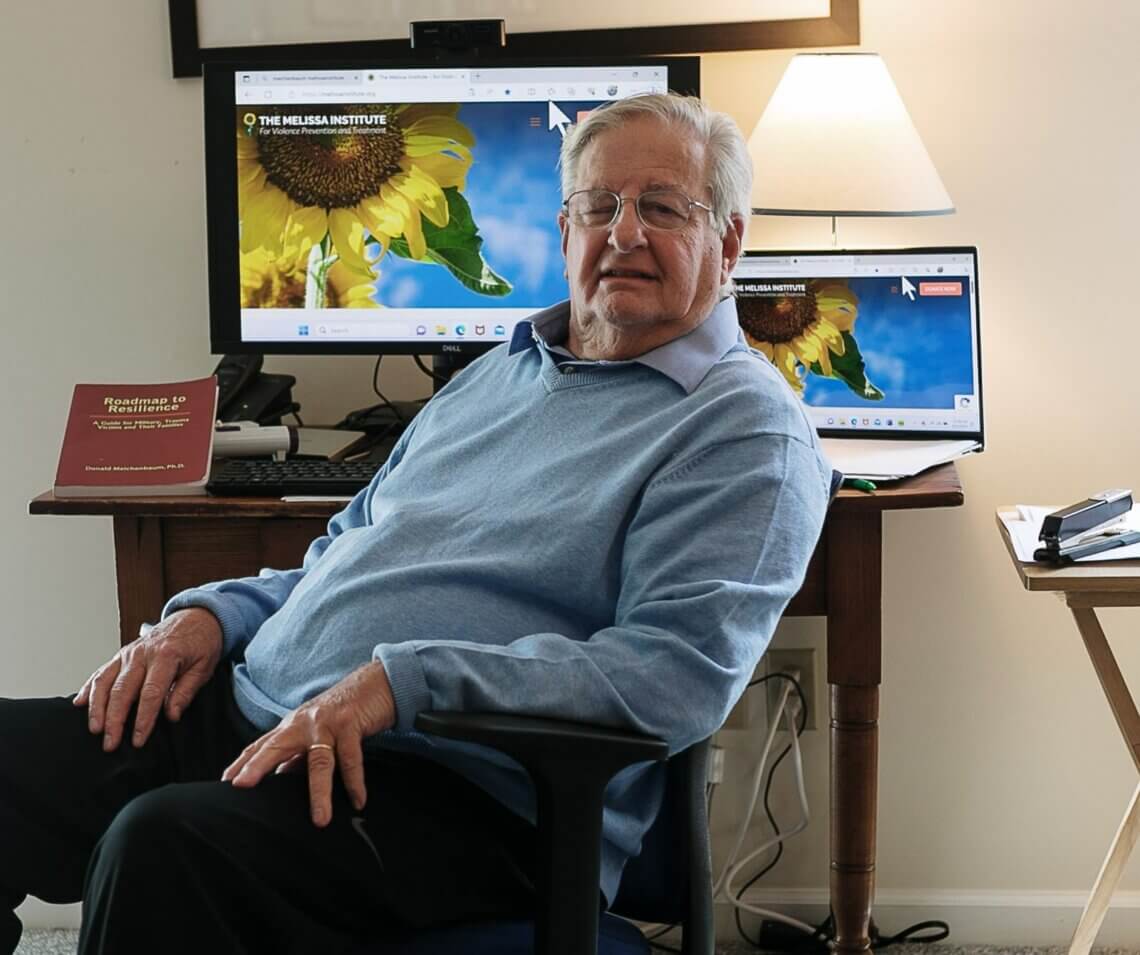
Professor Donald Meichenbaum chairs our Senior Advisory Board: Why this matters
I want to tell you why this matters so much to me, and why I think it matters for the whole field.
If you know who Don Meichenbaum is, you already understand why this is significant. If you don’t, I want to explain briefly, because the significance of this goes well beyond a prestigious name on a webpage.
Who he is
Don Meichenbaum is one of the three people who founded cognitive behavioural therapy. Together with Aaron Beck and Albert Ellis, he shaped the way a very large proportion of the world’s therapists think about how people change. In a 1982 survey of clinicians published in the American Psychologist, he was voted one of the ten most influential psychotherapists of the twentieth century. He is now in his mid-eighties, still working, and still, in my experience, the sharpest, warmest, most genuinely humble person in any room he enters. Also one of the funniest.
What made him different from the beginning, and what still makes him different, is that he didn’t just theorise about thinking. He understood thinking as something we do. He was influenced by Vygotsky, the great Russian developmental psychologist who showed that children acquire self-regulation by talking to themselves out loud, and gradually internalise that into what we call thought. We all know children do this: they narrate everything. What Vygotsky understood, and what Meichenbaum built on, is that this talking-to-yourself never stops. It goes underground. It becomes our private self-instruction. And we have more control over it than we typically realise.
That insight — thinking as an activity rather than a thing that happens to us — is central to everything he developed: Self-Instructional Training, Stress Inoculation Training, his constructive narrative approach. His clinical handbook on Stress Inoculation Training is still cited by the US Department of Veterans Affairs as an empirically validated treatment for PTSD.
He is an extraordinary teacher. I have used his videos and teaching in our courses for years. He communicates in a way where you don’t just absorb his ideas; you find yourself thinking in his voice. That is rare.
A champion against hype, which is why this means what it means
Here is something important to understand about Don. In 2018, he and the late Professor Scott Lilienfeld co-authored a paper called “How to Spot Hype in the Field of Psychotherapy: A 19-Item Checklist.” It won the award for the best contribution to the field of psychotherapy from the Journal of Contemporary Psychotherapy. It named hypnosis specifically as a domain where exaggerated claims — about special states, recovered memories and miracle cures — had done real damage. Don is also a vocal critic of what he calls “neurobabble”: the way neuroscience gets selectively and loosely invoked to add authority to claims that haven’t actually been tested.
This is a man who has spent decades pushing back against overclaiming in the very field I work in.
And that is exactly the ground we have been standing on for more than twenty years, sometimes rather uncomfortably within the hypnosis field. Our argument has always been that hypnosis does not need myths to make it powerful. It does not need claims about special trance states, unconscious reprogramming, recovered memories or miracle cures. It needs evidence, clarity, skill, and a better understanding of how attention, imagination, expectation, self-talk and behaviour actually work.
So when you ask what it means that he chairs our Senior Advisory Board, the answer is that it means the opposite of a rubber stamp. It means the approach we teach has been examined by someone with no incentive to be polite about it, no interest in flattery, and a well-documented commitment to calling out hype wherever he finds it.
Don has not come in to make us respectable from the outside. The alignment is deeper than that. He recognised, I think, that we were already trying to do something very similar from inside the hypnosis field: strip away the hype, keep what is genuinely powerful, and place it firmly inside modern cognitive behavioural science.
“What persuaded me is that the version of hypnosis this College teaches does not rest on those assumptions.”
He meant the assumptions about special states, recovered memories and miracle cures that have historically given hypnosis a bad name.
How we got here
I first reached out to Don in 2021. I had been using his teaching in our courses for years and had admired him enormously — as a thinker, as a communicator, as someone willing to say difficult things carefully.
But I also reached out because I had grown increasingly frustrated with the state of trauma discourse. There was so much noise, so much poor science, so many confident claims built on shaky foundations. Don had spent decades cutting through exactly this kind of confusion, with expertise, with humour, with rigour. I wanted the top person in the field to come in and give our students a clear, honest picture.
(A small aside: if you have a hero and you’ve been wanting to write to them, don’t hold back. You might be surprised at the response. I certainly was.)
Don replied warmly and immediately. That first workshop on treating PTSD and building resilience was exceptional. We ran it again as a fundraiser during Covid. Then he asked whether we would help him produce a legacy course — a distillation of fifty-five years of clinical and academic work, for future generations of therapists. We said yes. We spent eighteen months working closely with him, recording thirty lectures, rebuilding his legendary handouts, and producing The Essence of Psychotherapy, which is now available through the College. We also built and host his website at donaldmeichenbaum.com.
The Advisory Board chair is the formal expression of a partnership that has been building for several years now. It is deep, collegiate, and genuinely mutual.
The theoretical alignment, and why it runs so deep
This is the part that means most to me.
Don has long argued that we are not just Homo sapiens but Homo narrans — the storytelling animal. The stories we tell ourselves, the words we use internally, the meanings we make: these are not merely descriptions of experience. They constitute experience. That is the heart of his constructive narrative approach.
It is also the heart of Hypno-CBT®.
His work on self-instruction traces back through Vygotsky: we learn to regulate ourselves through inner speech, through the things we say to ourselves in the moments that matter.
Hypno-CBT® takes that insight and extends it. The reason focused, purposeful, believed-in self-talk works is that it is a form of autosuggestion. It is self-hypnosis in its most natural expression. The boundary between Meichenbaum’s self-instruction and therapeutic suggestion is thinner than either field has traditionally been willing to admit.
“A transdiagnostic, process-based approach that takes seriously the factors the outcome research tells us matter most, including the cultivation of expectancy and hope.”
That is Don’s own description of Hypno-CBT® — a precise and accurate summary of what we are trying to build.
What this means if you are a student or practitioner
It means the foundation you are learning from has been examined by someone with no incentive to be polite about it, and found to meet the standard.
For current course information, see the Diploma in Cognitive Behavioural Hypnotherapy.
It means the theory behind Hypno-CBT® — the way it accounts for how self-talk works, how stories shape experience, how focused imagining produces genuine change — connects to the deepest and most carefully tested strands of CBT. Not to a parallel tradition that happens to use similar language.
And it means you can study and practise with a degree of confidence in the intellectual grounding that many training programmes in this field simply cannot offer.
Professor Donald Meichenbaum’s full profile is on our website. His legacy course, The Essence of Psychotherapy, is available here. The full announcement is on our press page. The Senior Advisory Board page has further information. Professor Donald Meichenbaum’s profile page.
