

Why this Assessment and Conceptualisation Workshop makes you a better therapist
Effective assessment and case formulation is not only the starting point but the heart of the treatment plan in cognitive behavioural therapy (CBT) and cognitive behavioural hypnotherapy (CBH).
In a recent survey 1 in 6 adults had experienced some form of ‘neurotic health problem’ in the previous week – yet effective psychological treatments do exist for many of these mental health problems.
In order to prescribe the correct psychological treatment, however, knowledge of basic psychopathology is required as well as good assessment and conceptualisation skills. In addition, conducting a risk and protective factors assessment is a vital aspect of the initial meeting with a client or patient.
Learning the heart of the CBT method: Assessment and Case Formulation
Assessing and case formulation (also known as case conceptualisation) is therefore the most fundamental part of treatment in cognitive behavioural therapy. The cognitive-behavioural assessment is based on simple principles with clearly defined aims. The central principle of the model is the concept that the ways in which an individual behaves are determined by situations faced and the individual’s interpretations of these; this notion would therefore constitute the main focus of the assessment, with an emphasis on the specific details (such as maintaining factors) of a presenting problem rather that the more global aspect of it. Because the model has its basis in experimental methods, the earlier sessions are used to devise an initial formulation and treatment plan. Thus the principle aim of the assessment is to derive a preliminary case formulation which will form the basis for the future treatment plan.
This one-day workshop will explore and uncover fundamental skills in the CBT/CBH approach. The workshop offers a brief introduction to CBT theory with the aim of teaching participants the CBT skills of assessing clients and producing CBT formulations of their problems.
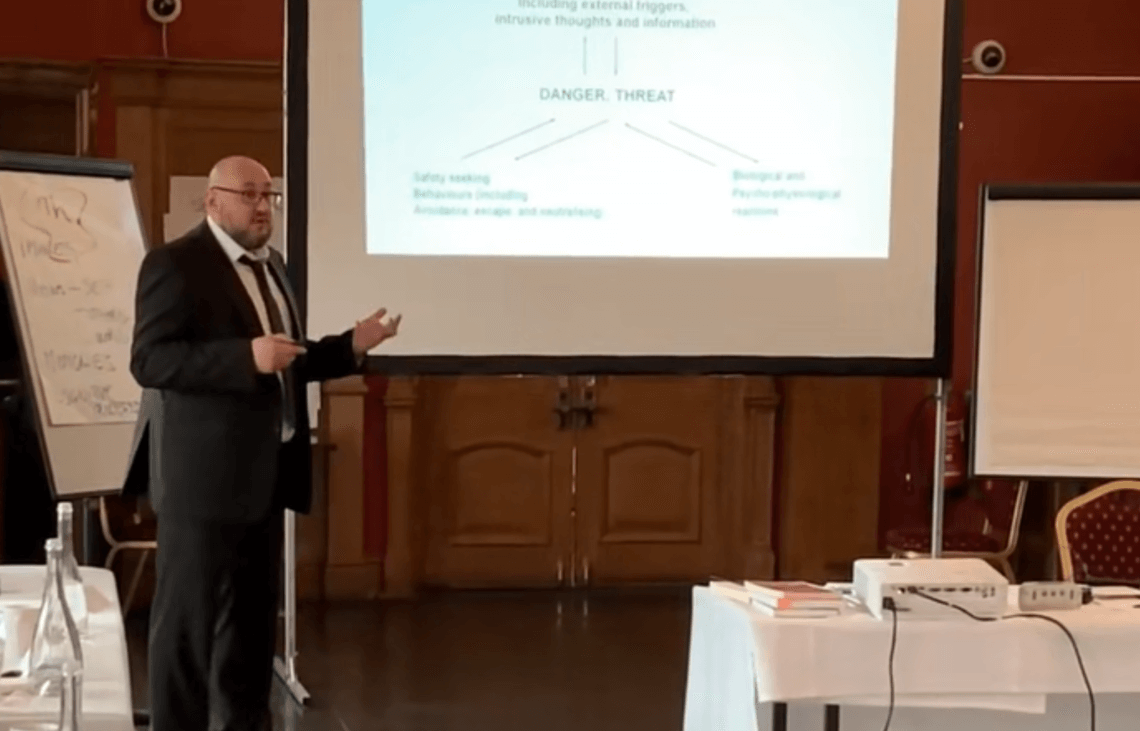
The workshop focuses on practical clinical skills through improvised role-play. The workshop facilitator will enact interventions with clients, leading workshop participants through the stages of assessment to produce a CBT formulation for the client (or patient). The format of the workshops will be a mixture of taught sessions, large and small group work, and skills practice.
The workshop is experiential and will focus on acquisition of assessment, formulation, engagement and planning competencies through case-based learning.
What this workshop will do for you
Learning objectives:
- Trainees will receive an in-depth introduction in CBT assessments and case formulations (or case conceptualisations) as well as treatment planning using the most reliable bio-psycho-social models (working models or vicious cycles) for clients suffering from a range of common mental health problems (such as depression and/or specific anxiety disorders).
- You will be able to understand the assessment and the main working models (or vicious cycles) of the most common mental health disorders, likely to present in your therapy room. For example, understanding the factors that maintain an anxiety disorder such as: the misinterpretation of situations; catastrophizing; paying too much attention to physical sensations; the misinterpretation of normal ‘internal symptoms’; an avoidance of situations that are likely to lead to anxiety; reliance on a range of safety-seeking behaviours, etc.
- By the end of the course you will be able to conduct a risk and protective factors assessment.
- You will understand the difference between ‘case-formulation approaches’ and ‘disorder-focused approaches’, based on evidence based protocols.
- You will gain experience in engaging the client in this process, assessing their coping strategies and helping them to articulate what they would like to gain from an intervention.
- You will learn how to engage the client in the case formulation so that it becomes a “collaborative conceptualisation”
- You will also gain experience in formulating and agreeing on a psychological treatment plan with the client – and how to conduct this so as to optimise participation and adherence.
- You will also gain experience in writing a comprehensive CBT assessment report.
- You will understand the self-report measures of commonly used at the assessment stage.
Treatment design and elements, specific interventions
- Introducing and socialising clients to the CBT model,
- Psychological education – about CBT and specifically perfectionism maintaining factors in CBT
- Modifying and challenging dysfunctional assumptions,
- Problem solving and setting realistic goals.
- Problem solving and setting realistic goals.
- The creative use of behavioural and social experiments as well as imagery work
- How to integrate different skills used in the treatment of depressive and anxiety disorders.
- The integration and use of hypnosis and negative self-hypnosis (negative autosuggestion model) into the CBT model
- The use of other more recent CBT approaches also know as third wave therapies such as mindfulness and acceptance, imagery, and relaxation.
What people have to say about the course
“An essential workshop for anyone new to clinical work. Informative and well-delivered by a very enthusiastic and knowledgable teacher. Highly recommend.”
– Kevan Laybourn, Cognitive-Behavioural Hypnotherapist and Emergency Care Practitioner
“I would recommend this workshop to anyone who would like to sharpen their case formulation and assessment skills. Daniel has helped bridge the gap between knowledge and application.”
“A workshop taught with insight, sensitivity and humour.”
– Rachel Church-Moore
Book now!
Available as Live Webcast Workshop by Zoom
Also available as Pre-Recorded Online Workshop
Live Stream Webcast
with Daniel Mirea, BABCP Acc
Fee: TBA
Upcoming dates: TBA
Live ‘classroom’ event with Daniel Mirea.
Ask questions live. Interact with course trainer and trainees. Experience Daniel’s dynamic and interactive teaching style!
Online (Recorded) Workshop: £108

Take the workshop as a pre-recorded online course
Train in your own time, at your own pace
Equivalent content and materials to the webcast
12 months access to the workshop