

Quick answers
- Is hypnotherapy licensed in the US? No state issues a licence for hypnotherapy as a profession in its own right. A minority regulate it by other routes: registration in Washington and Connecticut, practice restrictions in Florida, conditional exemptions in California.
- Is there one official national certification? No. Every hypnotherapy certification in the US is issued by a private organisation: either a training school or a membership body.
- How many training hours are typical? Anything from a weekend video course to more than 700 hours. Certifying bodies’ own minimums vary widely.
- Can you train online? Yes. The dividing line is live supervised practice with feedback, not the word “online”.
- What do we award? The Level 5 Higher Diploma in Cognitive Behavioural Hypnotherapy (Hypno-CBT®): a 500-hour programme including 136 hours of live taught training, assessed by four supervised case studies and a written assessment.
If you are researching hypnotherapy certification in the United States, you are shopping in a marketplace with no government licence, no single national board, and no agreed training standard. This guide explains how the system works: what “certified” means, who issues certifications, how many hours of training sit behind different credentials, what a handful of states require by law, and how to judge any programme, including ours.
Written by Mark R. Davis, FRSM, Principal of the UK College of Hypnosis and Hypnotherapy, which will become Hypno-CBT® College in September 2026. Last reviewed: 6/9/2026. Legal and organisational claims on this page link to their primary sources.
Hypnotherapy Certification: What It Means, Who Issues It, and How to Choose
- Is hypnotherapy licensed in the US? No state issues a licence for hypnotherapy as a profession in its own right. A minority regulate it by other routes: registration in Washington and Connecticut, practice restrictions in Florida, conditional exemptions in California. Details and statute links below.
- Is there one official national certification? No. Every hypnotherapy certification in the US is issued by a private organisation: either a training school or a membership body.
- How many training hours are typical? Anything from a weekend video course to more than 700 hours. Certifying bodies’ own minimums vary widely; the section on hours shows how to read the numbers.
- Can you train online? Yes. The dividing line is live supervised practice with feedback, not the word “online”.
- What do we award? The Level 5 Higher Diploma in Cognitive Behavioural Hypnotherapy (Hypno-CBT®): a 500-hour programme including 136 hours of live taught training, assessed by four supervised case studies and a written assessment, independently awarded and externally verified by NCFE, and approved through the BPS CPD Quality Mark Scheme for continuing professional development.
- Is Hypnosis Certification the same as Hypnotherapy Certification? No. Hypnosis certification would imply you understand how to induce hypnosis, phase and deliver hypnotic suggestions, and how to emerge someone from hypnosis, but it does not imply that you really understand how to use hypnosis therapeutically. Hypnotherapy certification would imply you know how to conduct an initial assessment, agree on goals, design a treatment plan centred around hypnosis and then deliver that treatment plan.
What “hypnotherapy certification” means in the United States
In the United States, “certified hypnotherapist” is not a government-issued title. There is no federal hypnotherapy credential, no state licence for hypnotherapy as an independent profession, and no national board whose certification every practitioner must hold.
When a practitioner or a school says “certified”, a private organisation issued that certificate. Two kinds of organisation do so: the school that ran the training, and membership bodies that recognise training and certify practitioners. The word tells you that somebody certified them. It does not tell you who, against what standard, or after how many hours of what kind of training. Those are the three questions this page equips you to ask.
One distinction American readers will know from other fields carries over here. A certificate records that you completed a course. A certification is meant to be an ongoing credential from a body separate from your training, usually with renewal conditions and an ethics code. In hypnotherapy the two blur, because many certifying bodies accept training delivered by their own approved instructors or member schools. Where a school says “our course leads to certification”, ask which organisation issues it and what that organisation requires beyond the course fee.
The value of hypnotherapy training lives in the training itself: the hours, the supervised practice, the assessment, and the external checking. Credentials differ enormously on exactly those points, which is why the rest of this guide compares them in those terms.
Hypnotherapy: certification, qualification, accreditation, registration, licensure: what each word tells you
Five words do most of the work in this market, and they mean different things in the US and the UK. Here is the map.
| Term | In the United States | In the United Kingdom |
| Certification | A private credential from a school or membership body. No single national certification exists. Anyone may lawfully be “certified” by somebody; the issuer and the standard are what matter | Used loosely; UK hypnotherapy courses more often award a “diploma” or “certificate”. The UK equivalent question is “who externally checks this qualification?” |
| Qualification | An informal word for whatever credentials you hold | A structured award. Some qualifications are government-regulated (listed on national registers); others are “customised” awards, quality assured by a national awarding organisation but not government-regulated |
| Accreditation | Usually means a private association approved a school or course. Separately, some states license or register the school as a vocational training provider, which regulates the business, not the therapy | Professional bodies accredit courses; above them sit awarding organisations (such as NCFE) recognised by the qualifications regulators for England, Wales and Northern Ireland |
| Registration | A few states require practitioners to register with a state agency before practising (Washington, Connecticut). Registration is a listing, not an endorsement of skill | Voluntary professional registers run by membership bodies. No state register exists because no UK statute regulates hypnotherapy titles |
| Licensure | State permission to practise a protected profession (psychologist, physician, counselor). No state licenses “hypnotherapist” as such | No licensure for hypnotherapy. The title is not protected in UK law either |
The practical use of the table: when a website says “fully accredited and board certified”, translate it. Accredited by whom, and is that accreditor anything more than a membership club? Certified by which board, and what did that board require? The answers separate serious programmes from certificate mills faster than any marketing copy.
Is hypnotherapy licensed in the US?
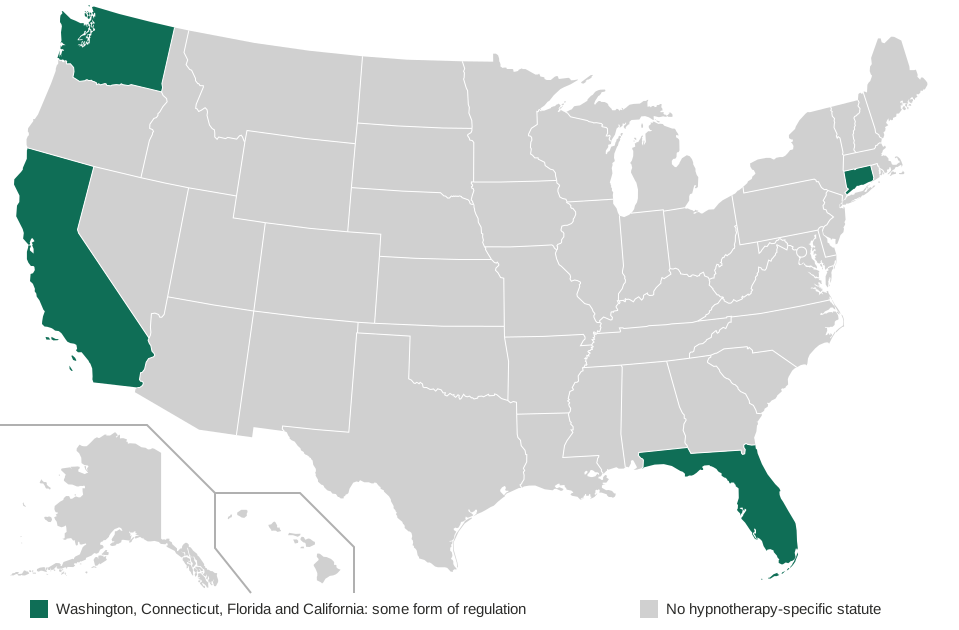
No US state currently licenses hypnotherapy as an independent profession. State law touches hypnotherapy in three ways: a small number of states require registration; at least one restricts who may practise therapeutic hypnosis at all; and licensing law for other professions (psychology above all) draws boundaries any hypnotherapist must respect. Four states show the range:
| State | What the law says | Source |
| Washington | Hypnotherapists must register with the state Department of Health before practising, under chapter 18.19 RCW (the counselors chapter) | WA Department of Health |
| Connecticut | Anyone practising hypnosis who is not already a licensed health professional must register with the Department of Consumer Protection and renew annually ($100). Licensed medical, dental, nursing, counselling and mental-health professionals are exempt | CT Department of Consumer Protection |
| Florida | Practising hypnosis “for therapeutic purposes” is unlawful unless you are a licensed practitioner of the healing arts or act under such a practitioner’s “supervision, direction, prescription, and responsibility” | Florida Statutes ch. 485 |
| California | No hypnotherapy licence exists. The psychology licensing law exempts people using hypnotic techniques “by referral from persons licensed to practice medicine, dentistry, or psychology”, or offering “avocational or vocational self-improvement” without treating emotional or mental disorders | Business & Professions Code s. 2908 |
Most other states have no hypnotherapy-specific statute, which leaves practitioners governed by general consumer-protection law, by unauthorised-practice rules for medicine and psychology, and in some states by disclosure laws covering complementary practitioners.
Three things follow for anyone planning to practise:
- Check your state before you train. Start with your state’s health department and consumer-protection agency pages; search “[your state] hypnotist OR hypnotherapist registration”.
- Watch the boundary language. Everywhere in the US, treating medical and psychiatric conditions is the business of licensed professions. Hypnotherapists without a clinical licence work on the non-medical side of that line or alongside licensed practitioners, and in Florida the statute makes the referral relationship explicit.
- If you already hold a clinical licence, your own board’s scope-of-practice rules govern how you add hypnotherapy, and the professional societies in the next section were built for you.
Laws change. This table was verified against the sources shown on 6th September 2026; we review it annually.
Who issues hypnotherapy certifications?
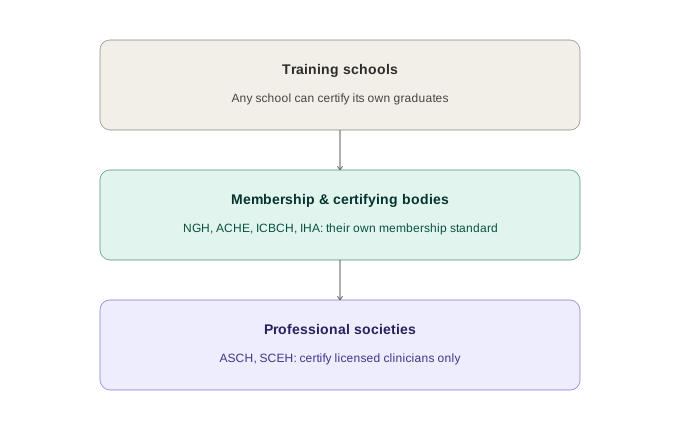
Three tiers of organisation certify hypnotherapists in the US. Knowing which tier a credential comes from tells you most of what it means.
| Tier | Who they are | What their certification means |
| Training schools | Every school can issue its own certificate of completion | Exactly as much as the training behind it: the hours, practice, assessment and external checking involved |
| Membership and certifying bodies (open to non-clinicians) | The National Guild of Hypnotists (NGH); the American Council of Hypnotist Examiners (ACHE), founded 1980, which also approves schools; the International Certification Board for Clinical Hypnotherapists (ICBCH), which certifies practitioners and recognises training from other organisations through a reciprocity route; the International Hypnosis Association (IHA) | Membership plus a certificate against the body’s own standard. Standards differ substantially between bodies, from recognition of prior training to examined programmes of specified hours. None is a government agency |
| Professional societies (licensed clinicians only: psychiatrists, doctors etc) | The American Society of Clinical Hypnosis (ASCH) certifies only practitioners “licensed in his or her state or province to provide medical, dental, or psychotherapeutic services” holding at least a master’s degree, and requires ASCH-approved workshop training plus “a minimum of 20 hours of individualized training/consultation with an ASCH Approved Consultant”. The Society for Clinical and Experimental Hypnosis (SCEH) requires a licence for independent clinical practice, 70 hours of approved workshop training including ethics and research components, and two years’ experience | Certification that you, an already-licensed clinician, trained in hypnosis to the society’s standard. Neither society certifies laypeople; ASCH states plainly that its credential “distinguishes the professional practitioner from the lay hypnotist” |
Two consequences follow.
First, “board certified hypnotherapist” always means certified by a private board. Ask which one and what it required; the honest answer is quick to give and quick to check.
Second, the tiering explains why advice online contradicts itself. A psychologist on Reddit saying “ASCH is the only certification that counts” and a career changer saying “NGH certified me and I built a practice” are both describing their own lane accurately. Which lane you are in is the first question in the how-to section below.
How many training hours does hypnotherapy involve?
Course lengths in this market run from a weekend of video to programmes of 700 hours and more, and almost every programme quotes a single impressive number. The number is uninterpretable until you know what kind of hours it counts. Five kinds exist:
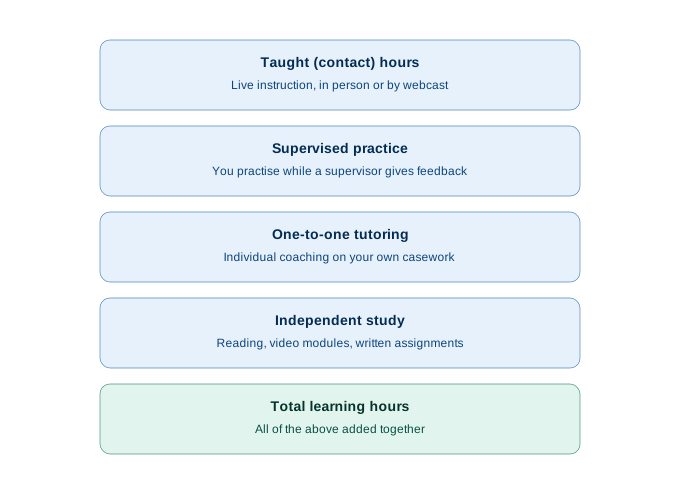
| Kind of hours | What it means | What to ask |
| Taught (contact) hours | Live instruction from a teacher, in person or by live webcast | How many, and are they live or recorded? |
| Supervised practice | You practising therapy with peers or clients while a supervisor watches and gives feedback | How many sessions, and who supervises? |
| One-to-one tutoring | Individual coaching on your casework and skills | Included or extra? |
| Independent study | Reading, video modules, written assignments | A realistic estimate, or padding for the total? |
| Total learning hours | All of the above added together | What is the split? |
A “300-hour certification” can be 300 hours in a classroom or 40 hours of video plus 260 hours of suggested reading, and both are sold with the same headline number. Ask for the split, and treat a refusal to give it as information about the programme.
For calibration, the certifying bodies’ own published minimums: SCEH requires 70 hours of approved workshop training (for already-licensed clinicians); ASCH certification is built on approved workshops plus a minimum of 20 hours of individualised consultation (likewise clinicians only). School programmes for career changers typically need to be far longer, because they must teach therapy itself, not just hypnosis as an addition to an existing clinical training. Duration in months matters less than the hours and their kind; our own students’ completion times are covered in the training FAQ.
We publish our own split in full below.
Can you become a certified hypnotherapist online?
Yes, and a large share of the US market now trains this way. Quality does not divide along online versus in-person; it divides on whether anyone qualified ever watches you work and corrects you, the quality of the content (ideally evidence-based, modern psychological science), the teaching design and methodology (up to date teaching methods) and the amount of individual vs group attention you recieve
A programme of recorded videos with a multiple-choice quiz certifies that you watched videos. A programme with live supervised practice, individual tutoring and assessed casework trains a therapist who happens to study from home. When comparing online certifications, apply the hours table above and add one question: how many times will a qualified supervisor observe me practising and tell me what to fix?
Our own online route to the Diploma pairs 100 hours of video modules with 18 hours of one-to-one tutoring and live supervised practice sessions running four times a week, because the live element is where competence is built. The full Diploma structure is described later on this page.
How to become a certified hypnotherapist: seven steps
1. Decide which lane you are in. If you already hold a US clinical licence (psychologist, counselor, social worker, physician, nurse and similar), you can add hypnotherapy through CPD-grade training, and the clinician societies (ASCH, SCEH) exist for you; our own programme trains both audiences together, and psychologists have a dedicated pathway. If you are changing career, you are training for the whole role, and the hours question matters far more.
2. Check your state. Registration in Washington and Connecticut, the referral requirement in Florida, exemption conditions in California, and nothing hypnotherapy-specific in most other states. The state table above shows the pattern and the primary sources.
3. Choose the training. Compare programmes on published hours by kind, live supervised practice, assessment, external checking and evidence base, using the checklist in the next section; the certificate follows from the training.
4. Do the training and the practice. However delivered, expect to conduct real supervised sessions repeatedly before qualifying. Our students typically conduct more than 30 therapist-client practice sessions before completing.
5. Pass a real assessment. Written work plus assessed practical casework, marked to a pass standard, is the pattern to look for.
6. Certify, join, insure. Obtain your certificate or diploma, join a membership body appropriate to your lane and country, and arrange professional liability insurance before seeing paying clients. Expect your insurer to ask for evidence of your training.
7. Keep training. Supervision and continuing professional development are what separate a practice that develops from one that repeats its first year forever. Serious certifying bodies require renewal hours, so build supervision and further training in from the start.
What to look for in a credible hypnotherapy training
Nine checks, in the order they eliminate options:
- Published hours, split by kind. Taught, supervised practice, one-to-one, independent study. A programme that will not publish the split does not make the shortlist.
- Live supervised practice. Somebody qualified watches you work and corrects you, more than once.
- A real assessment. Written and practical, marked to a pass standard by someone prepared to fail weak work.
- External checking. Someone outside the school verifies standards: an awarding organisation, an examining board, a recognised accreditor. Ask who checks the checker.
- An evidence-based curriculum that names its sources. If a school cannot tell you which research tradition its methods come from, it has none.
- Ethics training and a code with teeth. You will hold vulnerable people’s trust.
- Named teachers with checkable histories. Who teaches, what did they publish or practise, where can you verify it?
- A route to membership and insurance in your country. Ask which bodies accept the qualification and confirm with the body, not just the school.
- Plain policies. Refunds, deferral, complaints, in writing, before you pay.
Any serious school passes all nine without discomfort. Apply them to us in the next section
What the College awards: the Level 5 Higher Diploma in Cognitive Behavioural Hypnotherapy (Hypno-CBT®)
The UK College of Hypnosis and Hypnotherapy has trained practitioners since April 2003: more than 3,000 people through its courses, more than 2,500 Diploma students since 2006, across 76 countries. From September 2026 the College operates as Hypno-CBT® College. Our Senior Advisory Board is chaired by Dr Donald Meichenbaum, one of the founders of cognitive behavioural therapy.
The award itself, in the terms this page has been using:
| The question an American would ask | The answer |
| What is the credential? | The Level 5 Higher Diploma in Cognitive Behavioural Hypnotherapy (Hypno-CBT®). Hypno-CBT® is a registered trademark in the UK and the US |
| What kind of hours? | A 500-hour programme: 136 hours of live taught training across three stages, supervised practice sessions available four times a week (students typically conduct more than 30 therapist-client sessions), one-to-one tutoring on the online route (18 hours) and blended route (6 hours), and structured independent study making up the remainder. |
| How is it assessed? | Four supervised case studies and a written assessment |
| Who checks the school? | The Diploma is an NCFE-accredited Customised Qualification, “independently awarded and externally verified by NCFE” [K4]. NCFE is an awarding organisation recognised by the qualification regulators for England (Ofqual), Wales (Qualifications Wales) and Northern Ireland (CCEA Regulation). The certificate of achievement is issued directly by NCFE |
| What does “Level 5” mean? | NCFE has benchmarked the qualification’s learning outcomes and assessment criteria at Level 5 using national framework descriptors. In England’s framework, Level 5 is the level of a foundation degree, higher national diploma or diploma of higher education (gov.uk). The benchmark describes difficulty and depth of study; it does not make the Diploma a government-regulated award, and no US equivalence is implied |
| Is it government-regulated? | No. This is an unregulated qualification and is not a nationally recognised qualification. Hypnotherapy is not a government-regulated profession in the UK or the US; what varies between trainings is the external checking they submit to, which is why we publish ours |
| What professional recognition does it carry? | All formats of the Diploma are approved through the BPS CPD Quality Mark Scheme for the purposes of continuing professional development. Graduates are eligible to join UK professional registers including NCIP (the recommended route), the NCH, the GHR at full practitioner status, and ACCPH; international routes are listed on our accreditation page |
| What is the method? | Hypno-CBT®: an integration of hypnosis, cognitive behavioural therapy and mindfulness developed at the College, described in What is Hypno-CBT®? |
What the Diploma is not, stated plainly because this page has been teaching you to ask: it is not a licence, in any country. No hypnotherapy training on earth confers a right to practise that your state or country does not grant. What a serious qualification gives you is training you can defend, a credential an insurer and a membership body will recognise, and an examiner’s signature that means something.
For students in the US and elsewhere outside the UK
The Diploma is delivered live by webcast (times are UK; check the current timetable against your time zone), and through an online route built on recorded modules, one-to-one tutoring and live supervised practice sessions offered at varied times across the week, including evenings and weekends. Students in 76 countries have trained with the College, and the certificate NCFE issues is the same wherever you study.
For US graduates specifically:
- Graduates can apply for membership of the International Certification Board for Clinical Hypnotherapists (ICBCH) through a reciprocal membership agreement
- Membership of a US body is not a licence. Before practising, check your state against the table above, confirm how you may describe yourself there (some states regulate the words “hypnotist” and “hypnotherapist” differently), and arrange US professional liability insurance.
- Graduate Story: coming soon
Fees for students outside the UK are shown on our pricing for your country page, and the international students page covers how the online and webcast routes work across time zones.
Hypnotherapy certification: frequently asked questions
Is hypnotherapy licensed in the United States? No state issues a hypnotherapist licence. Washington and Connecticut require registration with a state agency; Florida restricts therapeutic hypnosis to licensed healing-arts practitioners and people working under their supervision, direction, prescription and responsibility; California exempts hypnotic work done by referral or for self-improvement from its psychology licensing law. Most states have no hypnotherapy-specific statute.
What does “certified hypnotherapist” mean? A private organisation, either a training school or a membership body, has issued that practitioner a certificate. It is not a government credential. The meaningful questions are who issued it, what training it required, and how the practitioner was assessed.
Is there an official national hypnotherapy certification in the US? No. Several private bodies certify hypnotherapists (among them NGH, ACHE, ICBCH and IHA, plus ASCH and SCEH for licensed clinicians), and none is a government agency or a single national standard.
Who certifies hypnotherapists? Training schools certify their own graduates; membership bodies certify practitioners against their own standards; and two professional societies, ASCH and SCEH, certify only licensed health and mental-health professionals.
How many hours of training does hypnotherapy certification take? There is no required number. Real programmes range from short video courses to more than 700 hours. Compare the kind of hours: live teaching, supervised practice and assessed casework are the expensive parts, and the parts that make a practitioner. Our Diploma is a 500-hour programme with 136 hours of live taught training.
How much does hypnotherapy certification cost? Self-paced online courses sell for a few hundred dollars; extended diploma-level programmes run to several thousand. Price the components: hours of live teaching, supervision, tutoring and assessment. Our current fees are published on the fees page.
Can I become a certified hypnotherapist online?
Yes. Insist on live supervised practice and individual feedback. Our online Diploma route includes 18 hours of one-to-one tutoring and live practice sessions four times a week.
Do I need a psychology degree to become a hypnotherapist?
Not in most US states or in the UK, where hypnotherapy is trained as its own discipline. Florida is the main exception, restricting therapeutic hypnosis to licensed practitioners and those working under them. The clinician societies (ASCH, SCEH) certify only licensed professionals; their credentials mark clinicians adding hypnotherapy to an existing licence, and the lay training lane remains lawful in most states.
What qualification does the College award? The Level 5 Higher Diploma in Cognitive Behavioural Hypnotherapy (Hypno-CBT®): an NCFE-accredited Customised Qualification, externally verified and issued by NCFE, benchmarked at Level 5 using national framework descriptors, and approved through the BPS CPD Quality Mark Scheme for continuing professional development. It is an unregulated qualification, as all hypnotherapy qualifications are; the external verification is the point of difference.
Is the Hypno-CBT® Diploma recognised in the United States? No hypnotherapy qualification carries US government recognition, because none exists. Graduates can apply for ICBCH membership through a reciprocal agreement [K1], insurers assess the training evidence itself, and the state rules above apply to everyone equally, however trained.
What is a Level 5 diploma in American terms? Level 5 is a UK framework level: the level of a foundation degree, HND or diploma of higher education in England’s qualification framework. The US has no comparable national framework for vocational awards, so no exact equivalence exists, and we do not claim one. NCFE benchmarked our Diploma’s learning outcomes at Level 5 to show its difficulty and depth of study.
Mark R. Davis FRSM is Principal of The UK College of Hypnosis and Hypnotherapy (from October 2026, Hypno-CBT® College), Principal and Director since 2013, and the originator of the Hypno-CBT® approach. The College has trained more than 3,000 people since 2003.
About the author

Mark R. Davis FRSM — founder of Hypno-CBT®, Principal of the UK College of Hypnosis and Hypnotherapy, Fellow of the Royal Society of Medicine.
Sources used on this page Washington State Department of Health, hypnotherapist registration (chapter 18.19 RCW) · Connecticut Department of Consumer Protection, hypnotist registration · Florida Statutes ch. 485 (2025), ss. 485.003-485.004 · California Business & Professions Code s. 2908 · GOV.UK, qualification levels in England · ASCH certification programme pages · SCEH certification pages · ICBCH (icbch.org) · NGH (ngh.net) · ACHE (hypnotistexaminers.org). All accessed 6/9/2026