

For psychology graduates, students and assistant psychologists
Put your psychology degree to work with clients
Hypno-CBT® is a cognitive-behavioural psychotherapy that uses hypnosis within a CBT framework. The Diploma is typically completed within 12 months and is most often used to set up ethical, well-defined private practice.
- ✓ Level 5 Higher Diploma, externally verified and awarded by NCFE
- ✓ Training holds the British Psychological Society CPD Quality Mark
- ✓ Study live online or at your own pace, with one-to-one tutoring
Prefer to watch first? See the session with Mark R. Davis and Dr Krissie Ivings
Senior Advisory Board includes Dr Donald Meichenbaum, one of the founders of CBT

A note from our Principal
If you studied psychology to help people change, the route into practice can feel narrow
The DClinPsy matters, and it’s what many of us hoped for. It isn’t the only way into applied therapeutic work. Counselling psychology, PWP and high-intensity CBT training, research roles and assistant posts all come with different costs, timescales and limits.
Hypno-CBT® is another option. This page sets out what it involves, how long it takes and where it fits, so you can weigh it up against the others.
Mark R. Davis
BSc (Psy & Phil), GMBPsS, FRSM · Principal, Hypno-CBT® College
How the routes compare
Rough figures for the main routes into therapeutic work in the UK. Each route leads to a different scope of practice and different settings, so time and cost are only part of the decision.
| Route | Qualification level | Typical time to practise | Training cost (est.) | Personal therapy required |
|---|---|---|---|---|
| Hypno-CBT® Diploma | Level 5 | 7–12 months | £5,972 | Not required |
| Counselling | Level 4–5 | 3–4 years | £10k–£15k | Yes (est. £1.5k–£3k) |
| Psychotherapy | Level 5–7 | 4–7 years | £20k–£35k | Yes (est. £5k–£10k) |
| Counselling psychology | Level 8 (doctorate) | 6–8 years | £60k–£80k | Yes (est. £6k–£8k) |
| Clinical psychology | Level 8 (doctorate) | 6–9 years | NHS-funded place | Optional |
Times include training before independent practice. Costs exclude living expenses.
What Hypno-CBT® involves
Hypno-CBT® is cognitive-behavioural in three specific ways, with hypnosis built into each one.
01
How hypnosis is understood
As focused attention, expectation, motivation and imaginative absorption. There’s no special trance state involved, and the work doesn’t rely on a Freudian unconscious.
02
How problems are understood
Anxiety, phobias and avoidance are formulated by what keeps them going now, using the same models you met in your degree.
03
What you do with clients
Teach new ways of thinking, approaching instead of avoiding, regulating emotion and solving problems. Hypnosis and mindfulness help clients rehearse those skills vividly.
If you know Beck, Wells, Meichenbaum, Wolpe, Jacobson, Hayes and Kabat-Zinn, you already know the foundations we build on.
What the research says
Two meta-analyses have compared CBT on its own with CBT combined with hypnosis. Both found that adding hypnosis improved outcomes on average.
These studies looked at CBT with hypnosis in general. They weren’t trials of Hypno-CBT® itself.
18
studies pooled by Kirsch, Montgomery & Sapirstein (1995)
48
controlled studies in Ramondo et al. (2021)
1,928
participants in the 2021 analysis
Watch the session with Mark R. Davis and Dr Krissie Ivings
Recorded for psychology graduates, assistant psychologists and DClinPsy applicants. Mark and Krissie talk through the pathway, the evidence and what the training can and can’t offer.
What it covers
- ✓ Why the psychology career pathway can become narrow
- ✓ What Hypno-CBT® is, and what it isn’t
- ✓ What the evidence says about adding hypnosis to CBT
- ✓ How the Diploma works as a vocational route into private practice
- ✓ How to judge whether it fits your background and goals

“Hypno-CBT® allows clients to safely experience positive changes in their imagination before committing to action. This training transformed cognitive and behavioural therapy protocols I used in practice into dynamic, enjoyable processes, leading to faster and better clinical outcomes.”
Dr Krissie Ivings, Consultant Clinical Psychologist · Head of the Hypno-CBT® Research Unit
The training
The Higher Diploma in Cognitive Behavioural Hypnotherapy
A Level 5 Higher Diploma, externally verified and awarded by NCFE. The training holds the British Psychological Society CPD Quality Mark.
The Level 5 Higher Diploma in Cognitive Behavioural Hypnotherapy is accredited by NCFE as a Customised Qualification and benchmarked at Level 5. NCFE is an awarding organisation recognised by the qualification regulators for England (Ofqual), Wales (Qualifications Wales) and Northern Ireland (CCEA Regulation). This is an unregulated qualification and is not a nationally recognised qualification. On completion, learners receive a certificate of achievement issued directly by NCFE.
Three strands, taught together
Clinical expertise
A toolkit of 35 evidence-based techniques, case formulation, and clear guidance on scope of practice and when to refer on.
Personal growth
Structured mindset work, including an inventory of limiting professional beliefs, so self-doubt doesn’t hold you back once you qualify.
Business skills
The 6F-9P business and marketing framework for therapists. You finish with a business plan, a financial plan and a Directory listing.
Two ways to study
Live webcast
Taught online in real time across three intensive stages, with trainer interaction, peer learning and live practice. You can join from anywhere.
Online self-paced
Study at your own pace with tutor support and 18 hours of one-to-one coaching from a qualified Hypno-CBT® practitioner.
Both lead to the same Diploma and the same NCFE certificate of achievement.
Diploma fee: £5,972 · BPS members: 10% off tuition
Free download
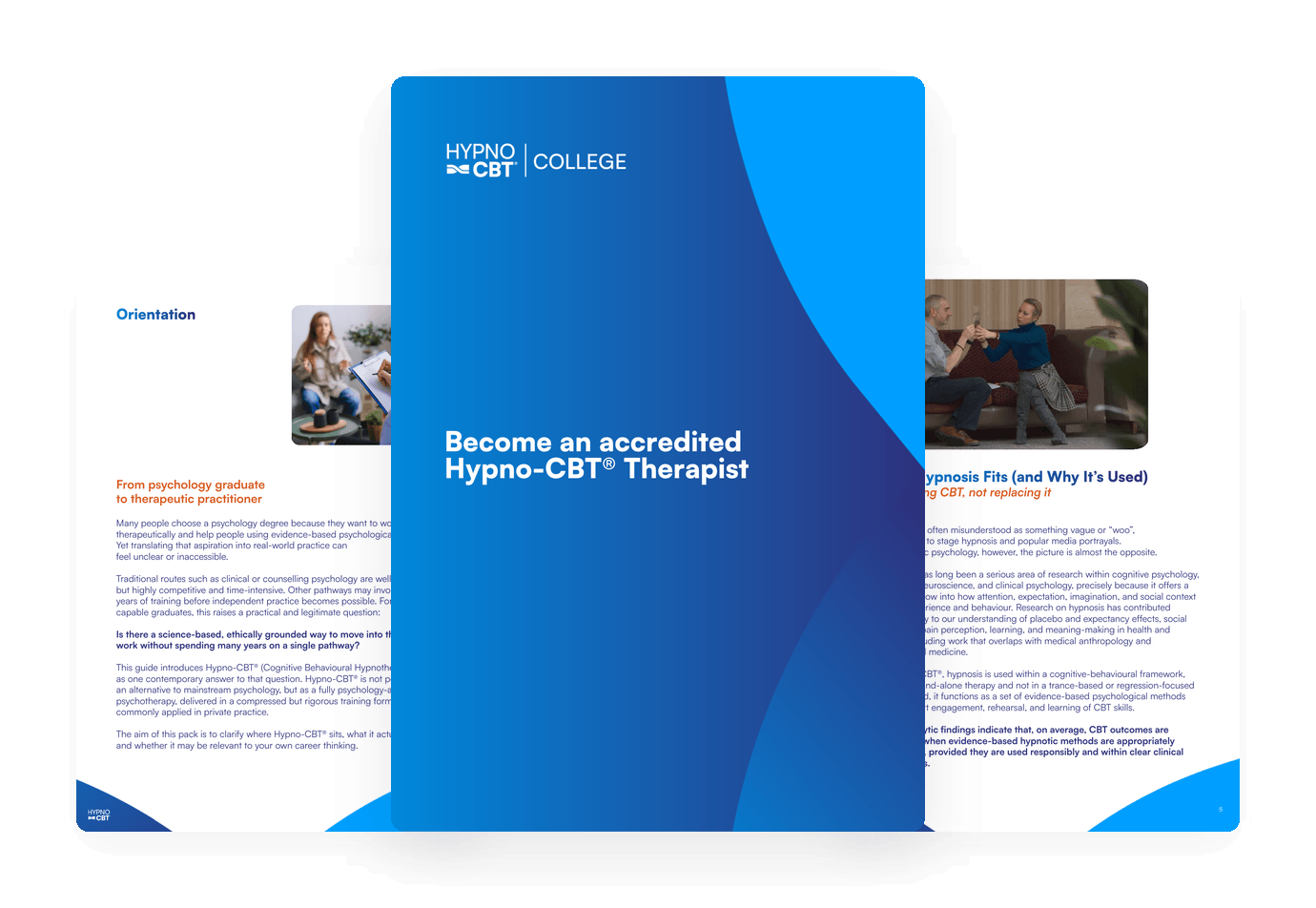
What’s in the career pack
- ✓ Where Hypno-CBT® sits within mainstream psychology
- ✓ How hypnosis is used within a CBT framework, and why
- ✓ How the training handles ethics, supervision and scope of practice
- ✓ The standards behind it: BPS CPD Quality Mark and NCFE Level 5
- ✓ Where practitioners apply it, from anxiety and habit change to chronic pain and IBS
Questions people ask
Do I need a psychology degree to train?
No. The Diploma is open to people from many backgrounds. If you’ve studied psychology, much of the theory will be familiar and you can put more of your attention on applying it.
Is this an alternative to clinical or counselling psychology?
It’s a separate route with its own scope. Hypno-CBT® practitioners most often work in private practice, within clear boundaries and with referral networks for anything outside their remit. Some qualified psychologists also train in it to add to their existing work. It does not lead to HCPC registration, or the protected title of psychologist. Hypnotherapy is not statutorily regulated in the UK.
How long does the training take?
Most people complete the Diploma within 12 months.
What qualification will I get?
A Level 5 Higher Diploma in Cognitive Behavioural Hypnotherapy, externally verified and awarded by NCFE. It’s a customised qualification benchmarked at Level 5, and on completion you receive a certificate of achievement issued directly by NCFE. This is an unregulated qualification and is not a nationally recognised qualification.
Is there a discount for BPS members?
Yes. BPS members get 10% off Diploma tuition fees.
Can I train from outside the UK?
Yes. Both the live webcast and the self-paced route are delivered online.
Rather talk it through first?
Book a short call with one of our course advisors. Tell us about your background and plans, and ask anything about the training, fees or what practice looks like afterwards.