
This is not a typical hypnotherapy training. It is a training in integrative psychotherapy: an integrative CBT centred around hypnosis and our hypnotic response to our own narrative, thoughts, and self-talk. The clinical model is Hypno-CBT®, developed over more than 23 years.
The Diploma is designed for novices and experienced therapists alike. We have been teaching those groups side by side for more than 20 years. It works. You can study this curriculum through the Online Diploma.
Learning how to think like a therapist
Many hypnotherapy courses give you scripts. Script A for anxiety, Script B for phobias. Or they teach you the most powerful technique available, and if that doesn’t work, try another. Regress the client to childhood. If that doesn’t work, try something else. This is what we call shotgun therapy: blasting away at the problem with no principled rationale for what you are doing or why.
That is not what you learn here. The Diploma teaches you to think like a therapist: gathering information, understanding what is maintaining the problem, developing a shared working model with your client, designing and delivering a tailored treatment plan, and monitoring progress throughout.
| Spiral learning: theory, practice, integration The training uses a spiral learning approach. You work through a key piece of theory, experience it in therapist-client pairs, debrief and discuss, then move to the next piece. As the spiral continues, the same core concepts return at greater depth. By the end you don’t just know the techniques — you have internalised a coherent way of thinking about people and problems. |
| “This is not just a script-reading course. You will learn the science behind hypnosis.” — Adam Cooper, Diploma graduate |
| “I do not see myself just as a Hypnotherapist but as a Psychotherapist, with the skills to offer a range of techniques.” — Danny Coates, teacher |
For novices and experienced practitioners alike
Our students come from every conceivable background: career changers with no therapy experience, practising counsellors and psychotherapists, psychologists, coaches, nurses, and doctors. We have been teaching all of these groups in the same cohort for over 20 years, and it works because the clinical model is rigorous enough to stretch experienced practitioners and accessible enough to bring complete beginners to full competence.
| “As an experienced practitioner, I took this course to learn a new way of working, and I can honestly say it has significantly expanded my psychological toolbox.” — Angela Darling, experienced practitioner |
| “When I took the course I was new to mental health. As well as being a hypnotherapist in private practice, I’m now also a clinician in the NHS.” — Theresa Brockway, career changer |
Our students come from every conceivable background: career changers with no therapy experience, practising counsellors and psychotherapists, psychologists, coaches, nurses, and doctors. We have been teaching all of these groups in the same cohort for over 20 years, and it works because the clinical model is rigorous enough to stretch experienced practitioners and accessible enough to bring complete beginners to full competence.
The central thread: building client’s self-efficacy
A central theme running through every stage of the Diploma is self-efficacy: the client’s belief in their own ability to cope with and handle challenging situations. Research consistently shows that self-efficacy is one of the strongest predictors of therapeutic outcome. Building it is not a nice extra; it is core clinical strategy.
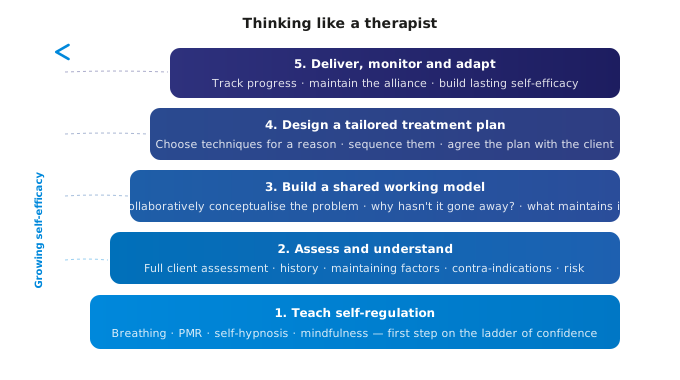
For example, before working on the presenting problem, you teach the client to self-regulate emotionally. That might be rapid muscle relaxation, Davis Tension Release Breathing, a mindfulness exercise, or self-hypnosis. The client who can calm their own nervous system when anxiety rises has already taken the first step on a ladder of confidence. Every subsequent technique builds on that foundation.
| “I come from a psychology background, including an MSc in Cross-Cultural Psychology, and still found the course genuinely eye-opening and highly practical.” — Natasha Russo, MSc Psychology |
| “The diploma in Cognitive-Behavioural Hypnotherapy is the only hypnotherapy course accredited by the prestigious British Psychological Society. It will deeply enhance applied psychologists’ range of effective interventions.” — Jonathan Pointer, Chartered Clinical Psychologist |
Three domains, one integrated model
The Diploma brings together three clinical domains. These are not presented as separate subjects; they are integrated into a single, coherent model of human experience and therapeutic change.
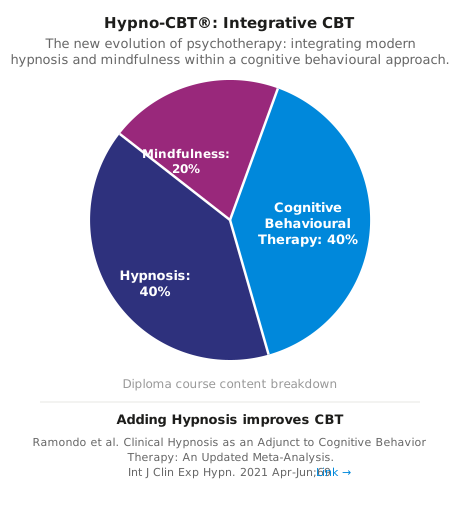
| Domain | Approx. | Key content |
| CBT (Integrative) | 40% | Behaviour therapy · cognitive therapy · REBT · problem-solving · stress inoculation · · assertiveness training · psycho-education · case conceptualisation |
| Hypnosis | 40% | Clinical inductions · suggestion · self-hypnosis · imagery · post-hypnotic suggestion · Hypno-CBT® proprietary techniques |
| Mindfulness / 3rd wave Therapies | 20% | MBCT · ACT · present-moment exercises · attention training · the full hypnosis-to-mindfulness attentional spectrum |
A toolbox of 35 evidence-based techniques
The Diploma teaches 35 evidence-based techniques. Every one sits within the same cognitive-behavioural theoretical framework: technically eclectic, but theoretically coherent. They all share the same understanding of how people get stuck and how they get unstuck.
This coherence is what allows you to choose a technique for a reason, and to design and deliver a tailored treatment plan that you and the client have collaboratively agreed upon. For example, a client with social anxiety and avoidance behaviour will need a different combination of tools from a client whose presenting issue is chronic tension and insomnia.
Some of the technique categories covered:
- Hypnotic inductions, deepening, and suggestion (multiple methods for different client profiles)
- Self-hypnosis, hypnotic skills training, and ego-strengthening
- Davis Tension Release Breathing (D-TRB), Jacobson’s PMR, and breathing relaxation
- Systematic desensitisation, graded exposure, and the Hypno-CBT® ABC Triple Exposure Technique
- Stress Inoculation Training and coping skills training (Meichenbaum)
- Cognitive restructuring: Socratic questioning, REBT disputation, behavioural experiments
- Mental imagery for cognitive change, time projection, and decatastrophising
- MBCT, ACT, and attention training
You can read about the full Hypno-CBT® Toolbox at ukhypnosis.com.
By the end of the Diploma you will have conducted over 30 therapist-client sessions: delivering hypnosis and receiving it, delivering CBT techniques and receiving them, delivering mindfulness exercises and experiencing them firsthand — each with a carefully structured feedback process. You leave not just knowing the techniques, but having lived them from both sides of the chair.
| “After finishing I felt I can actually help people in a very concrete and clear way. At the end of it I felt properly equipped to work with actual clients.” — Oana Serbana |
| “The diploma encourages a critical and creative approach to tailoring therapy to each client and their goals.” — Meltem Arikan |
The key question: how do problems maintain themselves?
A core clinical insight taught in the Diploma is that psychological problems are self-maintaining: thoughts, feelings, physical sensations, and behaviours feed one another in a cycle. A vicious circle has no single root cause — which is why “getting to the root” is often the wrong therapeutic goal. The right goal is to break the cycle, and Hypno-CBT® has tools to intervene at every point.
Frameworks: how to assess, conceptualise, and plan
Alongside the techniques, the Diploma teaches the clinical frameworks that allow you to deploy them intelligently. These are transdiagnostic: they apply across presentations rather than being locked to a single diagnosis or script.
- Client assessment: a full model covering history, maintaining factors, contra-indications, risk, and sphere of competence
- Case conceptualisation: developing a shared working model with the client, understanding what maintains the problem
- Treatment planning and delivery: selecting techniques based on the conceptualisation, sequencing them, and monitoring progress
- Therapeutic alliance: working collaboratively throughout, tracking the quality of the relationship, and adjusting when needed
- Transdiagnostic reach: anxiety, phobias, social anxiety, habit problems, low self-esteem, stress, pain, and more
The goal is that when a client sits in front of you, you are not searching for the right script. You are thinking about the person, gathering information, building a picture of why this problem exists and what maintains it — then designing and delivering a treatment plan tailored to them.
The 21 modules: three Stages of seven
The Diploma is structured as 21 modules, delivered in three Stages of seven modules each. Each Stage has its own clinical focus and builds deliberately on the one before.
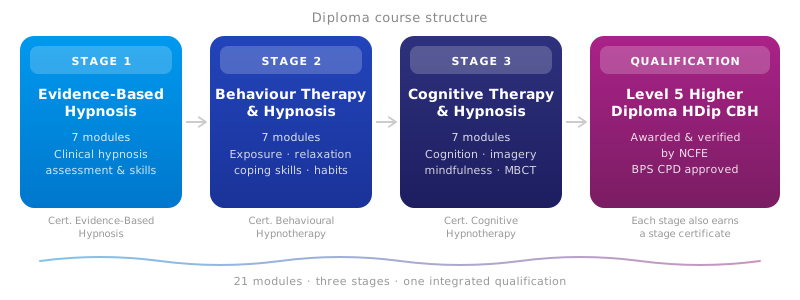
| Stage | Title | Clinical focus |
| Stage 1 | Evidence-Based Hypnosis & Basic Hypnotherapy | Master the clinical foundations of hypnosis; conduct structured client sessions; assessment and risk management |
| Stage 2 | Behaviour Therapy & Hypnosis | Integrate hypnosis with behavioural methods; teach clients to self-regulate; work with anxiety, phobias, and habits |
| Stage 3 | Cognitive Therapy & Hypnosis | Add cognitive, imagery, and mindfulness techniques; complete the clinical toolkit; practice planning |
The Diploma is structured as 21 modules, delivered in three Stages of seven modules each. Each Stage has its own clinical focus and builds deliberately on the one before.
The module-by-module curriculum detail is available on request and at ukhypnosis.com. What cannot be conveyed in a module list is the integration: the spiral learning, the proprietary Hypno-CBT® techniques, and the 23 years of refinement behind every session
What this course is not
The Diploma does not teach past-life regression or techniques that lack a basis in research. There is no script library to memorise. You will engage directly with the theoretical debates in the field — state versus non-state models, the research on suggestibility, the role of imagery in schema change — because understanding the science is part of what makes you a credible practitioner.
The qualification you earn
On successful completion you receive the Level 5 Higher Diploma in Cognitive Behavioural Hypnotherapy (HDip CBH).
| Qualification Level 5 Higher Diploma in Cognitive Behavioural Hypnotherapy A Customised Qualification awarded and externally verified by NCFE, benchmarked at Level 5 (Unregulated; not a nationally recognised qualification) | Post-nominals HDip CBH Quality Mark BPS CPD Quality Mark approved |
The qualification is accepted by all the main professional hypnotherapy registers: NCH, GHR, FHT, REBHP, ACCPH, ASCH (Australia), and ICBCH (USA). The Level 5 pathway also meets the requirements for full membership of registers that require Level 5. More than 2,500 students have completed the Diploma, with nearly 1,000 having qualified with the Level 5 Diploma awarded and externally verified by NCFE.
| “Provides an excellent basis for practising cognitive-behavioural hypnotherapy in a professional and effective manner. I highly recommend it.” — Professor Karen Carr PhD, Professor of Psychology, Cranfield University |
| “Evidence-based training: zero woo woo! Mark and his team deliver a comprehensive course for those with a healthcare background and those without.” — Dr Rosalind, healthcare professional |